Thursday, March 26, 2009

dada politics


in the early 1900's there was an "anti-art" movement called dada art that had the aim of
exposing the senseless nature of the bourgeois attitudes of the time and the intellectual culture that had led to world war 1. in this movement, practitioners would make works of art that were as absurd and senseless as possible.

some of the enduring classics we have from this time are the following:


and my personal favorite, "this is not a pipe"


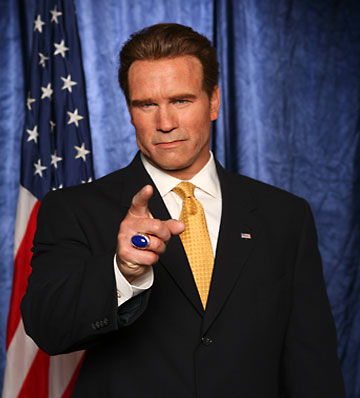
i suggest that its a good time for a dada politics movement. what sense is left in a system where uninformed people mindlessly vote for whichever pretty-faced candidate fit the most key words (change, hope, middle class families, etc) into their pre-packaged and processed prime-time interview? how 'bout when politicians dodge any actual issues when they're running and get people totally psyched about really bad ideas that sound fun (gas tax holiday anyone?) or when so many votes are divided neatly across party lines becuase nobody even reads bills, they just know if its a blue one or a red one. mr universe / action movie star for governor? great idea - that's a face we recognize.

in order to expose the absurdity of our current system, i propose the beginning of a dada politics movement. i suggest we campaign to get any of the following people in national office:

mike tyson
jack bauer
princess zelda
mr. t
one of the muppets
ike spencer
this guy
conan o'brien
hillary clinton... oh wait...
dwight shrute
miss teen south carolina
or this kid

maybe then we can realize that the people who look and sound real nice might not always be the best for our country, and that real issues are more important than the stupid political games everybody plays.

austinrory hackett

Posting Post

This afternoon I humbly accepted the offer to a posting post on this renowned blog. I thank Brad for the opportunity as well as the massive amount of aimless individuals who have spent numberless hours creating unread blogs all across the world.

My first post will be dedicated to the idea of fairness. Undoubtedly, fairness is an indispensable word in politics. It is one of the many ambiguous abstractions that provide political scientists with something to endlessly debate about. Fortunately, there are very few of us that publicly declare a stubborn allegiance to unfairness. We are all inclined to support policies we think are fair. The debate, of course, is about what fairness looks like, not whether we should work towards it.

I think Brad is right concerning the intent of most (if not all) liberal policies. They are all about control. This diction, to be sure, is bothersome to those who would support these policies. No one wants to be labeled an authoritarian. No one wants it to be said of them that they are all about control. (Just like no one wants to be for unfairness.) Despite the word's derogatory connotation in the world of politics, it is a sine qua non of government. This should go without saying, of course. Governments are instituted to control society. One might want to state this same fact more positively and say that governments are instituted to protect society. But regardless of the way one might describe this fact, the unavoidable truth is that politics has been, is now, and will always be about control.

This means, by the way, that Republican policies fall victim to the same fate, although "fall victim" may not be the correct phrase. To say that one "falls victim" to something implies a possibility for escape. For any political agent, however, there is no escape from this fact. One cannot simply step out of the political game, so to speak. That is to say, one cannot will oneself to a state of neutrality. We always care who wins in this struggle to control the political world, especially when the struggle concerns the values that are most dear to us.

I've learned that it is not the original sin of political action to have self-interest. In other words, it is perfectly okay to desire to win. That is, it is alright to want to govern (a nicer word for control). Nietszche would say that this desire is inevitable and that it is an amoral phenomenon. How one directs this impulse is up for moral critique, not the impulse itself.

I generally support conservative policies because I prefer the injustices, dangers, and anxieties of freedom to the constraints of "fairness." Exactly what the freedom I prefer is and who actually has it is something I will try to address later. For now, I simply want to suggest that a government (such as Obama's administration and the current Congress) that intends to control society and claims the ability to order things in a way that will produce fairness is kidding itself. Fairness is simply not possible for human beings. This is not, I admit, a reason to abandon the quest to realize it. But it is a reason to consider what it means to hand over so much power to men who profess a divine vision about what fairness is as well as the know-how to produce it. I don't think Obama claims to have perfect comprehension of what fairness is or how it can be realized, but I do think he believes he is more capable of mitigating unfairness than most anyone else.

It seems to me that a fundemental question one must ask oneself when making political decisions is, Are my political leaders capable of alleviating enough unfairness to make the surrendering of a portion of freedom worthwhile? I should add that it is not always personal freedom that is lost (it might be someone else's).

I plan to blog on the valuation of abstract goods like freedom and fairness at another time.

Saturday, March 21, 2009

Charity & Control

There shall be allowed as a deduction any charitable contribution (as defined in subsection (c)) payment of which is made within the taxable year.
-§ 170. Charitable, etc., contributions and gifts

Within President Obama's suggested budget is a proposal to end tax deductions for charitable donations.

The governing principle of policies formulated and executed by Democrats is control. The pursuit of control is manifest by that which lawmakers seek to both offer and obtain. Democrats identify problems and then create solutions for such problems. These solutions are control mechanisms - they control the poor by offering programs that generically and minimally solving problems; they control the rich by obtaining revenues that, in most cases, come from work, wit, risk, and luck (all of which entitle the individual to the potential reward).

This newest twist, ending tax deductions for charitable donations, is the latest and perhaps the ugliest manifestation of the pursuit of control. President Obama believes the projected $9 billion will be more effectively and more appropriately spent by him than by the individuals who earned it. Surely his justification will be the present economic crisis. Perhaps he will appeal to the roads that must be built, the health records that must be electronic, or the buildings that must be green. Whatever excuse his speechwriters find most politically agreeable, the governing principle is control.

Thursday, March 19, 2009

Reading & Outrage

"No money shall be drawn from the treasury, but in consequence of appropriations made by law."
-Article I. § 9

Congress last month passed a bill that President Obama signed into law, allowing AIG executives to keep their bonuses. The bill included an amendment from Senator Chris Dodd to limit executive bonuses strictly, but it included an exemption for bonuses agreed to "on or before February 11, 2009." That allowed AIG to proceed with the bonuses.

Congress yesterday expressed outrage upon learning that the bonuses had been distributed.

What did this story reveal?

1. Dishonesty - Sen. Dodd denied knowledge of the exemption on Tuesday, then was forced to admit that he, himself, drafted the exemption on Wednesday.
2. Victimization - Sen. Dodd blamed the Obama administration for pressuring him to include the exemption; Pres. Obama, at a town hall meeting, said: "The buck stops with me; I'm the president...(moments later)..."We didn't draft these contracts; we've got a lot on our plate."
3. Hypocricy - The Senate Finance Committee dragged AIG CEO Edward Libby to Washington, so that they could unfairly grill him for distributing the bonuses WHICH THEY AGREED COULD BE DISTRIBUTED WHEN THEY VOTED IN FAVOR OF THE BILL THAT INCLUDED THIS EXEMPTION!!!!!!!!!!!!!!!!

As my use of elite caps indicates, what most upsets me about this whole situation is that congress votes in favor of a bill and then a month later expresses outrage at a provision within the same bill.

To me this suggests indolence or incompetence. Either congressmen are not reading the bills they are voting on, or they are incapable of comprehending what they are reading.

I wish Libby would have grown some stones and lashed back at the hypocritical congressmen who told him he could do something and then condemned him for doing it.

The fact that Barney Frank angrily demanded the names of those who accepted the bonuses is UNBELIEVABLE. Rep. Frank agreed that those particular executives should receive their scheduled bonuses, and now he wants them to be publicly shamed for their greed.

Every American, especially the AIG executives, should be outraged at our joke of a congress.

Our lawmakers must be made accountable for what they lie about and what they fail to read.